
Interview
AI First: The Mindset Redefining Innovation. An Interview with Giorgio Lattanzi
2025-12-16
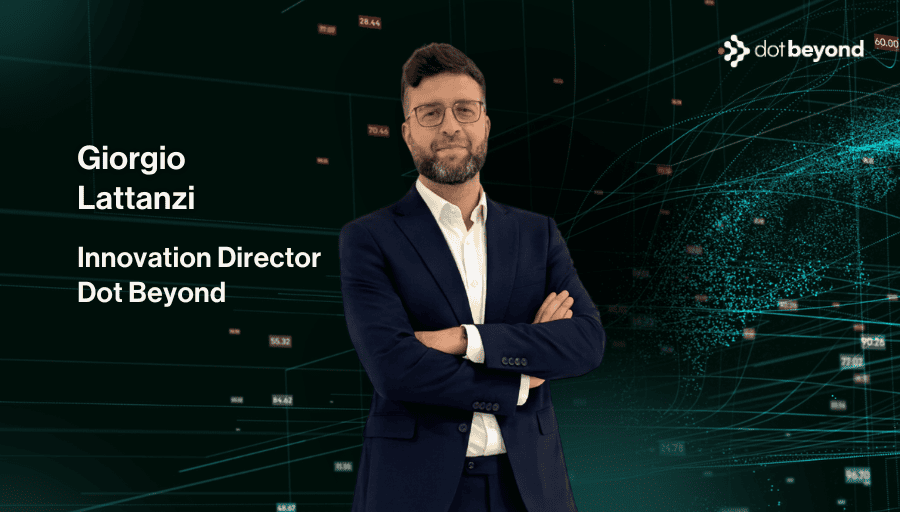
For our INSIDE VOICES column, we had the pleasure of speaking with Giorgio Lattanzi, Head of our Innovation Farm—Dot Beyond’s lab where technology trends are transformed into concrete solutions and new GenAI-based products. His vision perfectly embodies the “DNA” of curiosity and experimentation that drives our strategy.
Tell us about your background and your role at Dot Beyond. In particular, how does the Innovation Farm you lead translate the strategic AI vision into concrete solutions?
I started by founding Reiss Digital Life, with the goal of bringing digital solutions to market that combined quality and innovation. I began working on complex digital projects, where innovation was often more of a cultural challenge than a technical one. That drive to experiment quickly led us to constantly seek out the most advanced technologies and to develop proprietary products as well.
With the merger into Dot Beyond, we wanted to give continuity and structure to this DNA. This is how the Innovation Farm was born: our laboratory where we turn technological trends into tangible solutions for clients and into new GenAI-based products.
We run the Innovation Farm with an AI First approach at every stage of creation—from creativity and analysis, to prototyping, all the way through development and delivery. In practice, I support teams in translating strategic vision into measurable outcomes: we identify high-impact use cases, build rapid proofs of value, integrate generative models into real processes (marketing, customer care, operations, content), and ensure scalability, governance, and data quality.
The goal is twofold: to equip the company with new AI “weapons” and to bring products to market that address clear needs, making artificial intelligence useful, accessible, and sustainable for both people and businesses.
Can you share an example where AI played a decisive role, changing the approach, the client’s needs, or the project outcomes?
Rather than a single case, there are truly many. However, I prefer to focus on the essence: artificial intelligence has radically changed the way we think about and build projects—from the creative phase to design, all the way to actual development.
With the arrival of GenAI, something was unlocked that previously seemed complex or even impossible. Today, we can tackle challenges that until recently required long timelines or highly specialized skills. AI has made the dialogue between people and technology more fluid, helping us move from a linear approach to a more exploratory and iterative one, where ideas can be tested and refined in real time.
In many projects, this has meant completely rethinking client needs—no longer asking, “What can we do?”, but rather, “What can we enable AI to do to expand what we do?” This shift in perspective has improved speed, results, and overall quality of work.
AI is not just an enabling technology; it is a new way of thinking and creating value. The real difference lies in mindset: instead of resisting adoption, we must embrace it with curiosity and awareness. The sooner we do, the sooner we begin to reap the benefits in terms of speed, quality, creativity, and the ability to generate tangible value.
What are the real advantages of AI, and what are the most common myths?
The real advantages are clear: reduced time, improved decision-making quality, new creative possibilities, and access to insights that were previously unthinkable.
The most dangerous myth, however, is that AI “does everything on its own.” In reality, its value depends on the quality of the people guiding it, the data it is fed, and the context in which it operates.
Another misconception is seeing AI purely as an algorithmic issue. In truth, it represents a cultural and organizational transformation—it requires vision, governance, and above all, a new mindset of human–machine collaboration.
Looking to the future: how crucial are responsible scalability and sustainability—both ethical and environmental—in the development of AI solutions?
They are essential. AI is a powerful but also energy-intensive technology. We cannot speak of innovation if it is not sustainable, both environmentally and in terms of social impact.
At the Innovation Farm, we place strong emphasis on responsible scalability—solutions that not only work in the lab, but can grow sustainably over time, while respecting ethical principles and data privacy.
This also means working with more efficient models, using computational resources more strategically, and designing processes that consider the entire lifecycle of AI solutions.
How do you envision the evolution of AI in the coming years, and what opportunities could it unlock for sectors such as culture and gaming?
I believe AI is entering a new phase, where it will no longer be seen merely as a tool, but as a true partner in work and creativity. It will become increasingly intuitive, contextual, and integrated into everyday processes—better able to understand people and adapt to their needs in real time.
In business, it will enable faster decisions and deep personalization; in culture, it will help make content more accessible and interactive; in gaming, it will bring to life generative worlds that evolve alongside the player.
But the most interesting aspect is not only technological—it is cultural. AI is changing the way we think and create. It pushes us to collaborate differently, to experiment, and to go beyond the limits of what once seemed possible.
Those who embrace it with curiosity and openness, without fear, will discover that it does not replace human intelligence—it amplifies it.
To conclude: “Innovation doesn’t come from models, but from the people who question them in new ways. AI is just the beginning of a broader conversation between technology and imagination.”
2025-12-16
Let’s find out if it’s a match
contact us